
Opening keynote, Sourcing Summit Europe, Amsterdam, 7 October 2026. Photo: SOSU Europe.
Attended SOSU and looking for the slides? Phil Tusing shared them with attendees.
Also in French: Le grand pivot.
The theme of Sourcing Summit Europe this year was authenticity. So I opened it by telling a room full of sourcers, my own community, the one thing nobody in that room wanted to hear: there won’t be as many of us.
That may be authentic. It wasn’t easy. I didn’t say it to be provocative. I said it because I build these machines, I watch what they can do every week, and pretending otherwise to a room of people I respect would have been the real insult. The good news, and there is some, is that the job doesn’t end. It moves. A pointsman doesn’t stop the train, he switches the track. That’s the pivot.
This is the written version of that talk, with the slides that matter and the reasoning that didn’t fit in forty minutes. And on Friday 16 October, I’ll be debriefing SOSU live on Hung Lee’s Brainfood Live.
Turn people into candidates
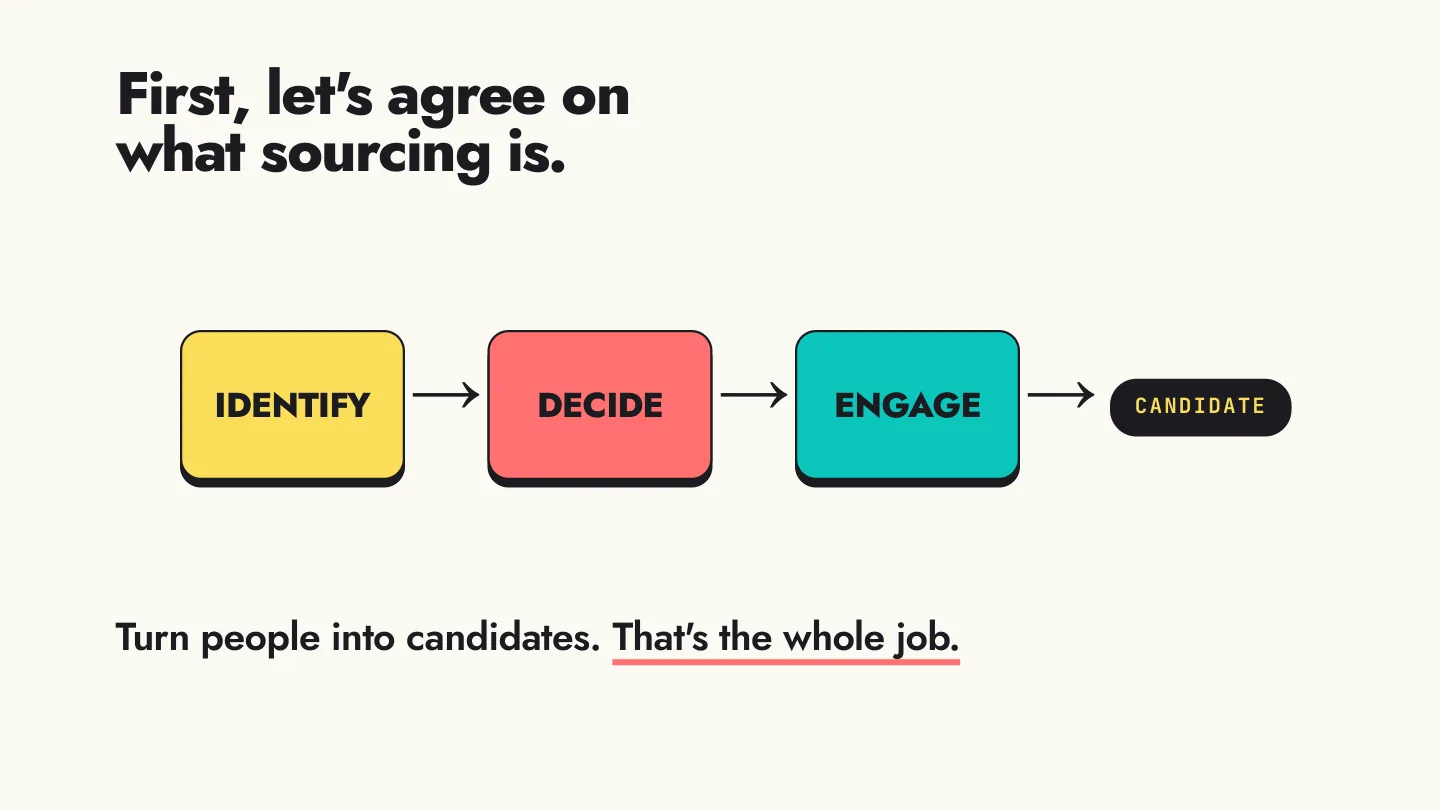
Strip sourcing down and it fits in one line: you identify people, you decide whether they fit, you engage them. You turn people into candidates. That’s the whole job.
Now take each step and ask whether a machine can do it.
Identify. You can launch sub-agents on the open web today: market mapping, data enrichment, deep research, all in parallel. A machine does it.
Decide. A human qualifies a profile in a few seconds, tired by the fortieth one and biased from the first. A machine reads the whole profile, every time, and explains its yes or its no. A machine does it.
Engage. With empathy, which is the step everyone assumes is safe. I built a tool that gathers what a profile says, runs locally, and writes a message tailored to that one person. A machine does it.
So the honest answer is yes, on all three. With one condition, and the whole talk hangs on it: if, and only if, it has access to the data.
That condition doesn’t weigh the same on each step. Deciding is already solved. I don’t mean keyword matching with a nicer interface. I mean reading every profile and reasoning about it the way a good sourcer would.
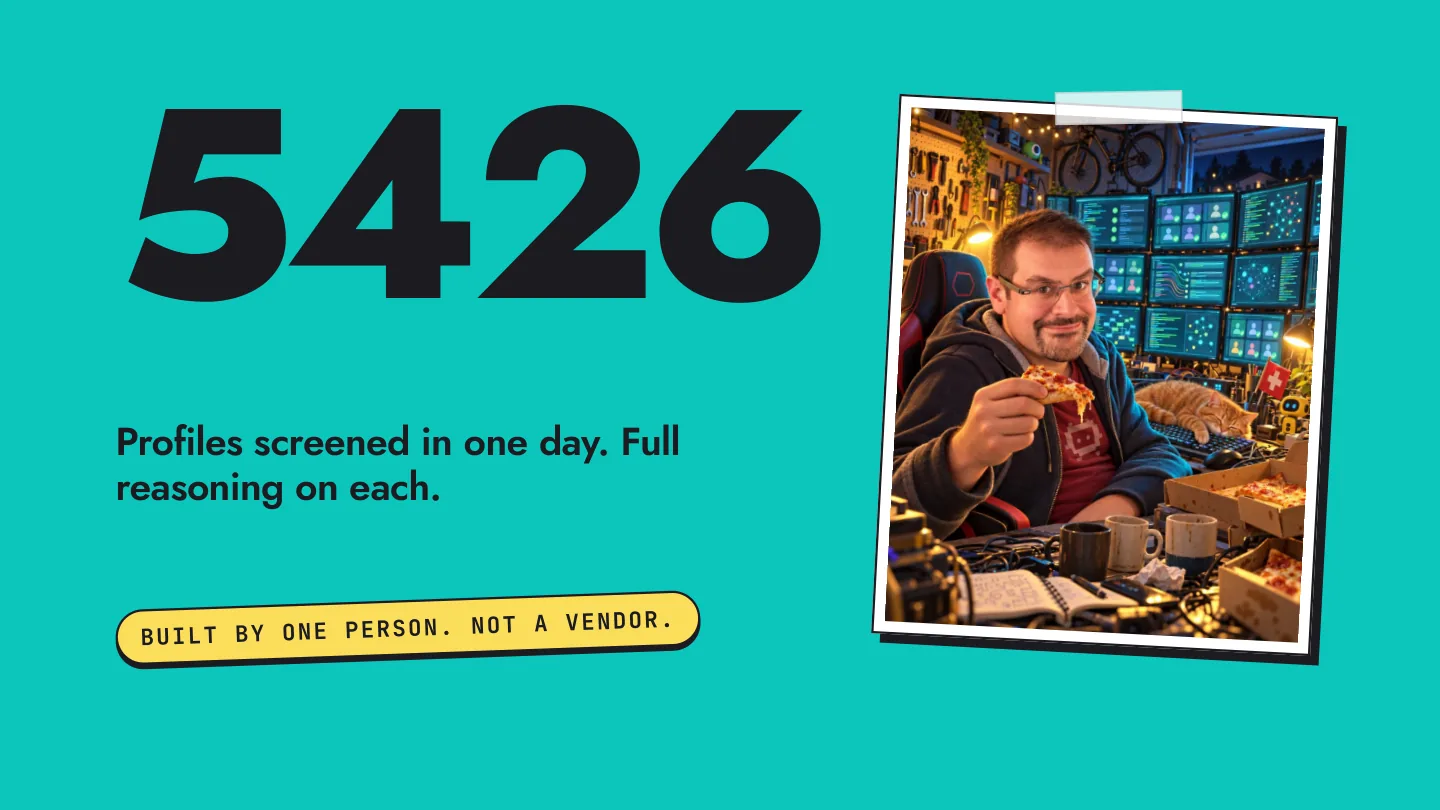
5,426 profiles in one day, each one analysed in full, each verdict argued. Built by one person, not a vendor. The models are still a little heavy for this kind of work, and they are getting lighter fast. I’ll come back to that.
Identifying is where the condition bites. A machine can only identify people it can see.
Access to the data
Open web data is rarely enough to recruit at scale. You find fragments: a GitHub account, a conference talk, a blog post, a company page. What you almost never find is structure: the current role, the location, the career path, the skills, in one place, for everyone.
That structure exists in exactly one place. So I asked the room a simple question: is there such a thing as public LinkedIn data? And I said: prove me wrong.
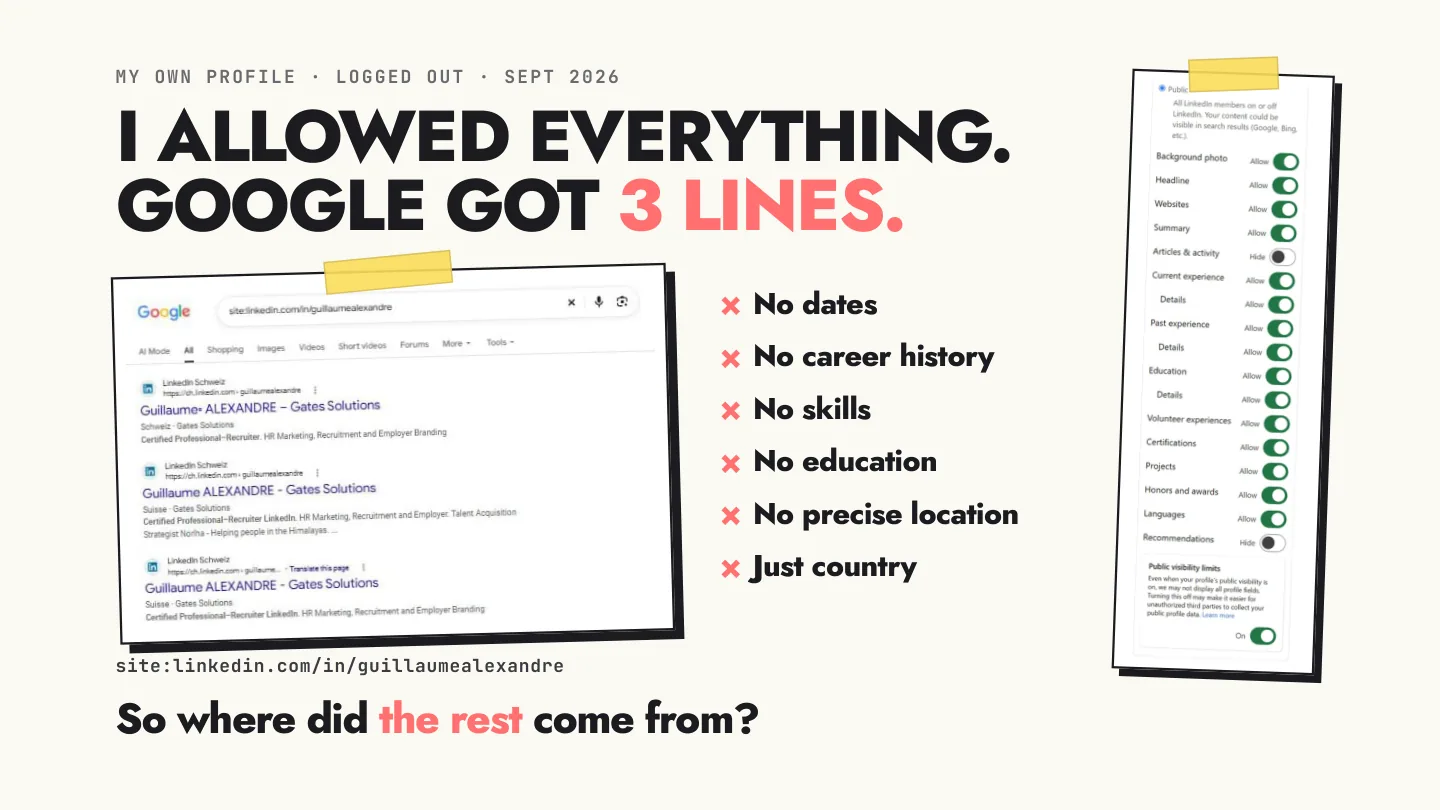
I tested it on myself. Every visibility setting on my own profile switched to public, then I looked at it logged out. Google got three lines. No dates, no career history, no skills, no education, no precise location. Just a country. Which raises the obvious question: when a tool shows you a full profile, where did the rest come from?
My test isn’t an accident. On 13 November 2025, LinkedIn put almost everything that makes a profile useful for sourcing behind its authwall, the page that asks you to log in or create an account: the current position, the experience with its dates, the education. Data providers documented the drop themselves: in their logged-out collection, those fields went from being filled on roughly half to two thirds of profiles to about 2%. Since that day, career history is no longer public. You see it as a logged-in member, which means under LinkedIn’s user agreement.
Someone always answers: “But hiQ won.” What everyone remembers from that case is that scraping public data is not a computer crime in the US. What people forget is how it ended, on LinkedIn’s user agreement, and that the door hiQ walked through no longer exists. In 2017, a profile was visible without an account. Today the same “public” profile sits behind the authwall, and getting past it means accepting the contract.
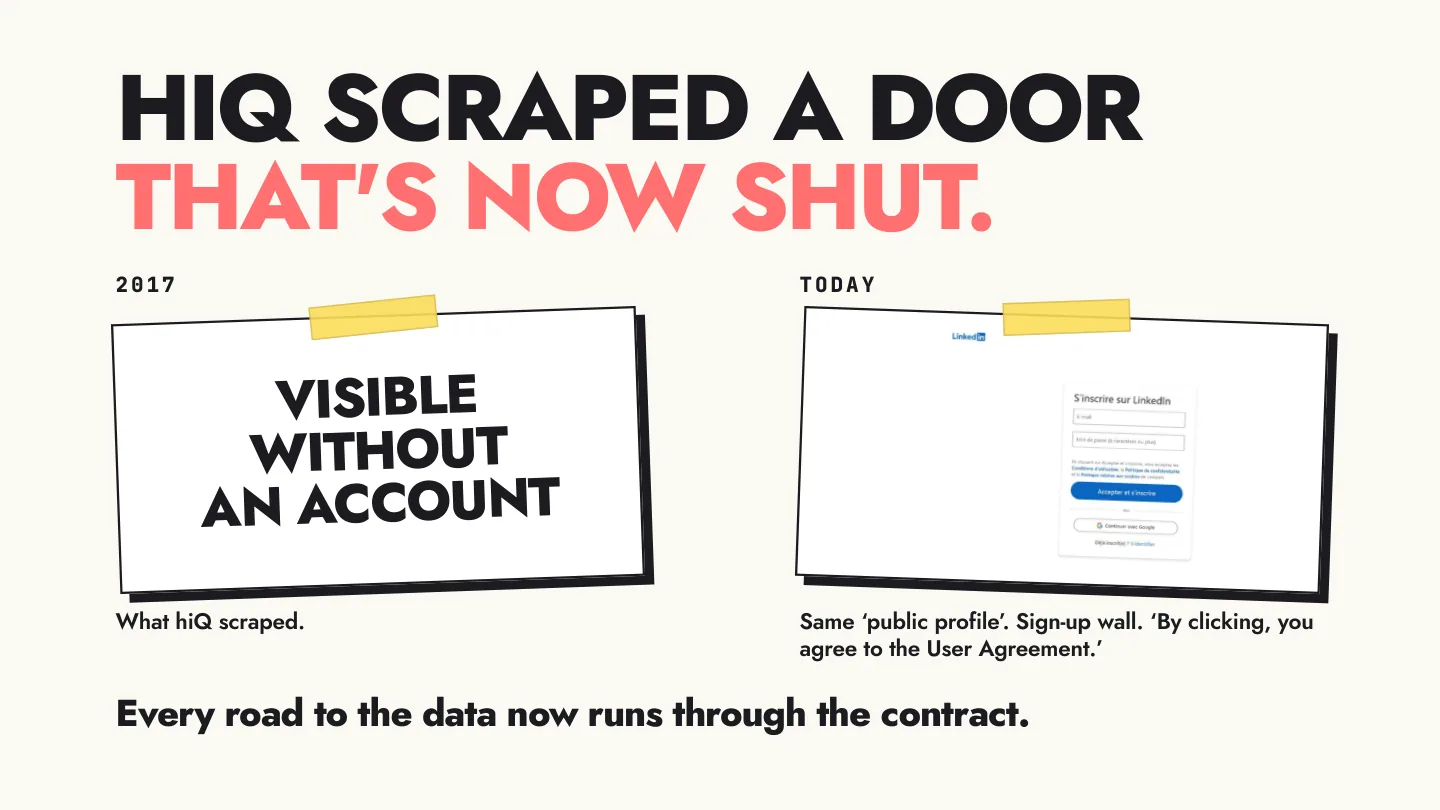
Every road to the data now runs through the contract.
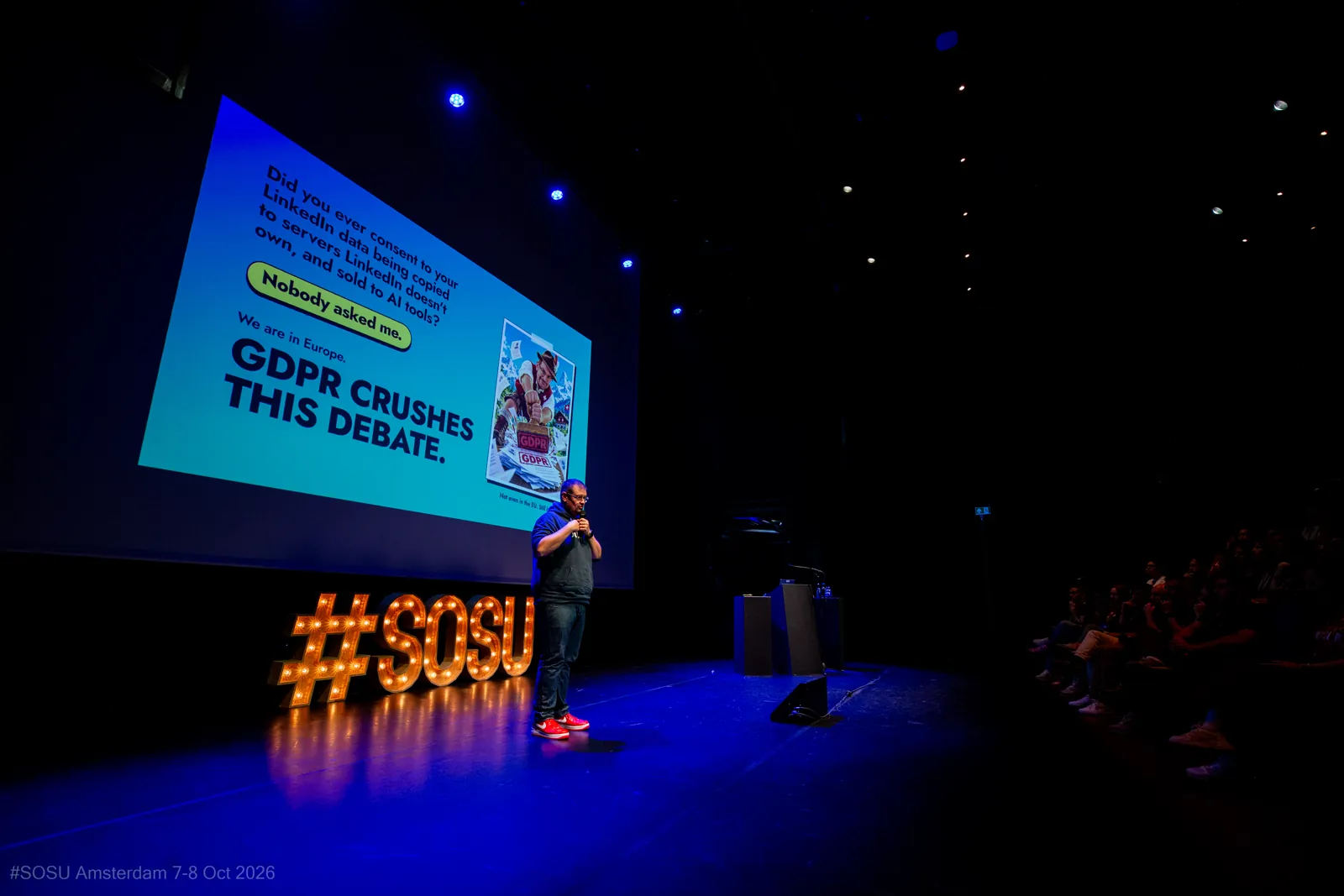
And we are in Europe. Did you ever consent to your LinkedIn data being copied to servers LinkedIn doesn’t own, and sold to AI tools? Nobody asked me. Under GDPR the question isn’t whether something can be scraped, it’s on what legal basis, with whose consent, and after which notice.
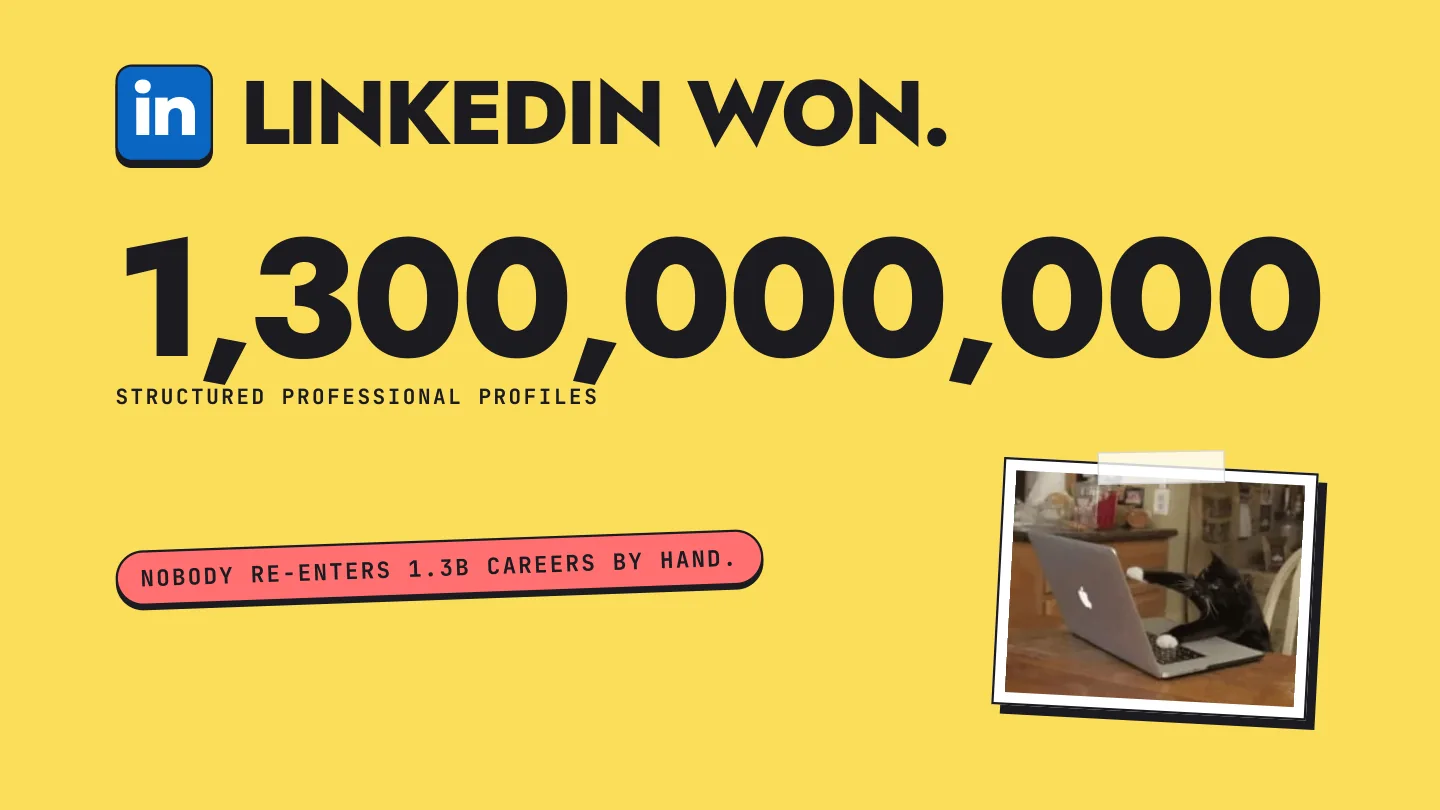
Which leads to the uncomfortable conclusion of the first half of the talk. The vendors don’t have the data. LinkedIn does: 1.3 billion structured professional profiles that nobody is going to re-enter by hand.
More on this soon. Where sourcing vendors actually get their LinkedIn data, and whether they’re allowed to, deserves more than a paragraph. I’m working on an in-depth piece. Questions and right-of-reply requests have gone out to several platforms, and I’ll publish once they’ve had the chance to answer.
So if LinkedIn has the data, does LinkedIn solve the problem? That’s where the second half of the talk started, and where it got more interesting.